Categories
Article

Slug Fest (Prevention and Removal)

Slugs are sneaky garden pests! They are:

  • Adaptable
  • Feed on a wide variety of organic matter
  • Seclusive… leading to be elusive.

The solution? Take an integrated pest management approach.

  1. Assess the damage.
  2. Evaluate your options.

We have a lot of tried and true ways to get rid of these slimy un welcome visitors to your garden.

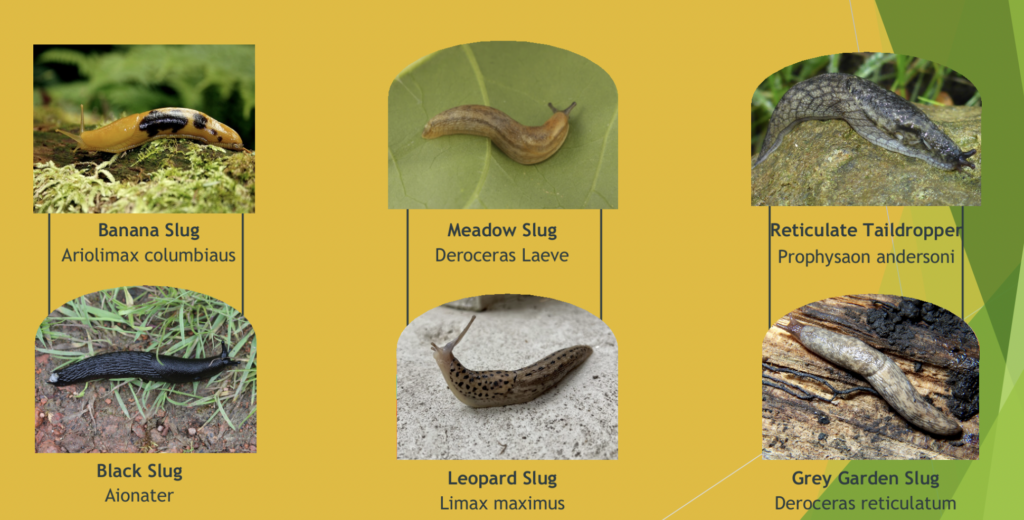
Native and Non-native Alaskan Slugs
Evidence of a slug problem

  • A dried slime trail left behind
  • Weak or dying plants
  • Irregular shaped holes in leaves, stems, flowers and fruit
  • Seedlings injured or damaged
  • Check any cool, moist areas with shade and you find some

Protecting the garden

First step: Identify the Pest

Slugs are slimy, soft bodied, without legs. Generally muted natural colors, except the banana slug. Has two pairs of feelers, top are the eyes, lowers are used for smelling. Range size from ¼” in to 2” plus. Set a “Refuge trap” to monitor population. Using a flashlight, look for slugs at night.

Use the below strategies or a combination of them to rid your garden of slugs:

  • Manual Control
    Hand removal can be productive if a few slugs exist. Check in the early morning hours on and under leaves, under rocks and debris. Promptly place into a cup of salty or soapy water. Discard dead slugs properly, as the smell is unpleasantly fragrant. Wear gloves during removal, as slugs natural response to predation is to release a large amount of mucus.
  • Natural Predators
    Juvenile slug predators are beetles, frogs and spiders. Mature slug predators are domestic, migratory birds and shrews.
  • Sanitation
    Slugs are attracted to decaying matter, removing dead or half eaten plants helps to maintain proper garden sanitation. Prune lower leaves of plants to increase light exposure; divide or thin plants to improve air circulation to dry out soil; improve drainage of soil.
  • Garden Design
    Plant in rows 12 – 18” apart, applying a barrier in between rows. Stake plants to raise plants off the soil, to reduce access. Create an inhospitable garden by switching wood chips for gravel in garden pathways. Plant perennials that like drier conditions: yarrow, wormwood, milkweed, asters, ornamental grasses, bee balm, sage, tulips or daffodils. Remove materials where slugs hide, such as containers, boards, pavers and flat stones (see the trap technique below). Consider container planting, instead of in-ground.
  • Watering Schedule
    Water in the morning at the base of the plant. Avoid over watering. Water by hand, drip irrigation or use soaker hoses
  • Barriers
    • Copper foil, mesh or bands react with the mucous, giving them an electrical like shock.
    • Electric Slug barrier
    • Raised beds made out of metal or plastic
    • Make a ring of pistachio shells around plants
    • Diatomaceous earth; dries out the mucous layer, but needs multiple application after watering or rain.
  • Baits/Traps
    • Set out beer traps; bury containers level to ground, pour beer or other fermenting liquid that is 6-7’’ deep. As slug tries to take a drink, they fall in and drown.
    • Grapefruit rind, boards or wet newspaper; these will be an attractive place to hide during the day. Check in the morning and discard slugs properly.
    • Sacrificial companion plants
  • Topical Pesticides (store bought and homemade remedies)
    Apply the commercial pesticides in the late afternoon or evening when the slugs become active. Sprinkle product around the plants that are being protected.
    • Iron phosphate is a stomach poison that damages the slug’s digestive system. (Sluggo)
    • Ferric Sodium EDTA is less toxic than iron phosphate, quicker killing time. (Corry’s Slug & Snail Killer)
    • Make your own home made slug spray: Mix 1/3 ammonia to 2/3 water, spray on the slugs that you see on your plants. The Ammonia burns their soft membranes and will kills the slugs.
  • Plants slugs do not like:
    Lavender, rosemary, sage, ferns and nasturtiums, mint and hyssop, garlic and chives.

Hope this helps in the wet and soggy stretches of weather Anchorage can experiences during the growing season.
Categories
Article

Recommended fruit and veggie variety list for Southcentral Alaska

Although our short growing season, colder soils, and unpredictable weather create some interesting challenges, this is a special place to garden. Our longer daylight filled days and low pest levels give us a gardening edge over the Lower 48.

Our fantastic partners at the UAF Cooperative Extension maintain a full list of fruits and vegetables that work for our region!

Two people unveiling the I St. garden beds

Find out what fruits and veggies really work

Although there are many varieties that are not included in the UAF Cooperative Extension listings, the ones that are there have been proven successful in Southcentral Alaska. One of the joys of gardening is discovering new varieties that are successful in your garden. So have fun and try things out in your property’s microclimate. You might just have a spot that grows something extraordinary!

P.S. By extraordinary, we mean something like avocados… We know the science, but we can all still dream right!?

Categories
Article

Reality Check: Alaska’s Food Supply

Learning to grow your own food is important in today’s economy

The Anchor Gardens organization was created due to the COVID-19 shipping disruptions. Our founders realized that when our supply chain is disrupted, shelves go empty and people go hungry. Only 5% of the food Alaskans consume is produced in the state, everything else we eat is shipped in from out of state or out of country.

The increased occurrence of harsh weather conditions and environmental disasters is causing food shortages and price increases worldwide. These disruptions are caused by severe thunderstorms, wildfires, hurricanes, droughts, flooding and unexpected frost during the growing season. They often damage entire crops that are intended for our local grocery stores. Disease outbreak and pest infestation can also affect availability and increase food prices. Lastly, economic decisions made by all levels of government, union strikes, and FDA food recalls all affect our food supply in Alaska.

Tariffs are Coming

Due to the change in the Federal Government Administration, a federal tariff increase on imports is proposed for 2025. The tariff increase varies from 10% to 60%, depending on what country it is being imported from. The Anchorage Assembly already approved a Port tariff for goods shipped to the Port of Anchorage; to help pay for the Port of Alaska Modernization Program. Consumers who receive goods through the port will see this increase take effect on January 1, 2025. The tariffs will rise from $0.59 per ton to $4.80 per ton. A rate increase of nearly 800%.  Read the Port of Anchorage Terminal Tariff and view the annual rate increases. This also made the news: With Port of Alaska tariffs rising, consumers may see slightly higher prices on goods statewide (Alaska News Source) One company, SpanAlaska, has already decided to raise rates by 7.5%. They notified their customers on Nov 15, 2024 of the rate increase, which goes into effect Dec 15, 2024.  Bottom line: there’s no way around it, these costs will be passed on and you’ll see it in store’s price tags.

Learn to grow your own food with Anchor Gardens!

Anchor Gardens realizes that the combined increase of tariffs on imported goods, natural disasters and food recalls create a serious food security problem. Together, we can reduce this problem by learning how to grow our own food in our backyards and shared community gardens. Our neighborhood coaches are here to teach the community how to sustainably harvest wild plants, grow cool weather vegetables and fruits. They can teach you how to create a microclimate on your property or use greenhouses to grow the produce that needs a warmer, more humid environment than a typical Alaskan summer provides.

In the table below are common food imports you find in the grocery store, and if they can be grown in Anchorage. Some items can be grown with or without a greenhouse in your backyard or even indoors. Some items, such as wheat and barley, are more difficult for “backyard gardeners” to grow but can be purchased from professional Alaskan farmers.

Common shipped in items but could be grown in Alaska

Food ItemOutside GardenGreenhouse/Indoors
Apples Yes, Hearty varietiesYes, but a very large one
Asparagus yes
Barley yes
Basil yesyes
Beans Yes, pole and bush
Beets yes
Blueberry yes
Bok choyYes, also does well in containers
Broccoliyes
Brussel Sprouts yes
Cabbage yes
Carrots Yes, also does well in deep containers
Cauliflower yes
Celery  Yes, also does well in containers
Chard yes
Cherries Yes, hearty varieties
Chives Yes, also does well in containers. And is perennial.yes
Collard Greens yes
Corn Yes
Cucumber yes
Currents Yes
Kale yes
Lavenderyesyes
Leeks yes
Lemon Balmyesyes
Lettuce- Iceberg Yes, also does well in small containers
Lettuce- Romaine Yes, also does well in small containersyes
Mint yesyes
Onions yes
Pears Yes, Hearty varietiesYes, but a very large one
Peas Yes
Peppers noyes
Potatoes Yes, also does well in large containers
Pumpkin yes
Radish Yes, also does well in deep containers
Raspberry Yes! Definitely!
Rhubarb yes
Rosehips yes
Rosemary yesyes
Spinach Yes, also does well in small containersYes
Strawberries Yes
Tomato Yes, if siberian variety or in a warmer microclimate on your propertyYes, with lots of varieties to choose from.
Turnips yes
Winter squashes yes
Yarrow yesyes
Zucchini Yes, also does well in large containers

Learn more about what is currently grown in Alaska and its seasonal availability at Alaskan Grown.

Anchorage is mostly USDA Hardiness zones 4 and 5 with Girdwood now a Zone 6, which means there’s just some things that need a warmer and more humid or drier climate that Alaska just can’t provide. Therefore, they’d still be an import to Alaska:

  • Bananas (Guatemala, Ecuador, Costa Rica, Colombia, and Honduras)
  • Oranges (South Korea, Lower 48)
  • Mandarin Oranges (Lower 48)
  • Lemons (Lower 48)
  • Limes (Lower 48)
  • Coffee (Hawaii but mostly multiple warmer climate countries)
  • Cocoa (Hawaii but mostly multiple warmer climate countries)
  • Vanilla Bean (Mexico, Tahiti, Madagascar)
  • Avocados (Mexico)
  • Nuts (Lower 48 and other countries)
  • Olives (Other Countries)
  • Grapes (Lower 48)
  • Mango (Asian countries, Mexico)

Buy Alaskan

We can also challenge ourselves to eat Alaskan. Buy Delta Barley instead of oatmeal or other cereals at the store; sign up for a CSA from a local farmer; or shop at the farmers markets first before going to the store to buy imports. All of these purchases will naturally increase demand from local farmers so that they can expand their production. If every Alaskan just spent $5.00 a week on Alaskan products it would seriously impact our economy. “If every Alaskan were to take this challenge it would put tens of millions of dollars back into the local economy,” Division of Agriculture Director Arthur Keyes said.  So join Anchor Gardens to become more food secure and to grow Alaska’s economy.  

If you have questions, want to learn how to garden either in your own space, or plot at a community garden we are here for you and want you to succeed. Join the Anchor Gardens Network and learn more about our growing community. 

References: 

Categories
Article How to

How to begin a garden

Our friends at Yarducopia have a great video series on beginning gardening techniques! Find it on their website: Row By Row Video Series

Video of Anchor Gardens workshop from 2020:

Categories
Article How to

How to sharpen your garden tools

Sharp tools will make your work a lot easier! Thanks to Dohnn Wood for these tips!

Categories
Article How to

High Intensive and Polyculture Planting

Thanks to member Dohnn Wood for these tips!

Categories
Article How to

Urban foraging

Thanks to Kristi Wood for these tips on urban foraging!

(Videos from 2020)

Categories
Article

Videos!

We hope you enjoy these recorded presentations! The first is from the 2020 Alaska Food Policy Conference and features Cindee Karns and Theresa Brown. It is about one hour long and the title of the presentation is Anchor Gardens: a grassroots effort building community and food security in Anchorage

Want just the quick and dirty? This 4-minute Get Involved with Anchor Gardens presentation by Cindee Karns for the Alaska Common Ground’s Food System’s Roundtable, part of an ongoing series on Anchorage’s Climate Action Plan, was held in March 2021

Link: https://youtu.be/lm-glJMFvW8

Categories
Article

Thinking in Systems – Cultivating Durable Networks for Lasting Food Security

When you join Anchor Gardens, you will be asked to complete a short survey and contribute to a network map by identifying existing connections within the group. This is voluntary and data will not be shared beyond the group. We are attempting to sketch out connections and relationships so that we can see where our strengths lie and also see where and how best to channel resources today and tomorrow.

The run on grocery staples in Anchorage in March and April of 2020 was a blunt reminder that Alaska is at the end of a long supply chain. For some who grew up in Alaska before the pipeline, it felt like a return to the pre-pipeline days. For many others, the small inconvenience of not having flour or yeast for a few months actually shocked us into believing we should do something. It would be a shame not to harness this long overdue momentum around improving local food security to build durable change. One way we are doing this is through a dynamic network map. We hope you will contribute and welcome additional collaborations and improvements.

Permaculture Designers are trained to think in Systems; to ask how can we improve the system; to ponder where are the system’s shortcomings.  Most designers start with FOOD:  growing your food close to home just strengthens your system.  If you add chickens or goats, it strengthens your system more.  If you learn to build your own house out of materials only from Alaska, your system is really secure.  And most importantly, if you build a strong community with people you trust, you can survive.  Permaculture Designers have tried going it alone in the Alaskan wilds.  They have come back to report that they can’t do it alone.  It needs to be done together, destroying the myth of Alaskan Rugged Individualism.  We have a strong network so we can call on people we know to teach us the next thing, or to share bounty with.  That network became visible in Anchorage this spring with the arrival of the pandemic and launching of this Anchor Gardens project. It is now spreading farther and becoming more diverse and resilient by the day.

We want to keep this network visible, especially as it does continue to grow and diversify. We want to see how interconnected and interdependent we are, because that brings strength to us.  We want to honor local businesses, because it brings strength to us.  We want to share our bounty, because it brings strength to us.  We want to care for people who have lost jobs or homes, because it brings strength to us.  Who knows what outcomes will come from this, but we are bound by our strength. We need to embrace what emerges so that we can learn our way into the future—TOGETHER. 

We wonder, what would happen if there were a directory of anyone in the municipality wanting to help Anchorage become more food secure?  What would happen if anyone in the network, could look up who in town is willing to share goat poop?  Or seedlings, or labor, or mulch?  What would happen to Anchorage’s food security? 

“The most successful networks and movements are defined not by their strategies for action, but by a common purpose informed by shared values and principles.”  – Lindley Mease & David Ehrlichman

Please join our network and add your strength to ours. 

Categories
Article

Our Beginnings – How it all started

Anchor Gardens was launched in March 2020 as an antidote to fear, isolation and food insecurity brought on by the COVID-19 pandemic.

The run on grocery staples in March and April of 2020 was a blunt reminder (and for some, a realization) that less than a week’s supply of food is readily available on grocery store shelves, even in the best of times. Alaska is at the end of a long supply chain, which depends on critical logistics and infrastructure that are not shock-proof.

A group of friends — mostly students and faculty from the Alaska Cold Climate Permaculture Institute — got talking and brainstorming about our city’s dependence on imported food and products. As hunkered down home gardeners,  we started planting seeds, physically in greenhouses and under grow lights; and also within our networks and communities.  Expert gardeners stepped forward and volunteered to mentor their neighbors and others interested in learning to grow food.

We set a goal for ourselves to establish five (5) new home gardens in every community council area in Anchorage (for a total of 180). From our network, we reached out to each community council area to have a coach step forward and volunteer to teach/coach/organize new gardeners in their area. 

Volunteers stepped up to create Facebook groups for each community council area. Volunteers started gathering materials to build gardens—things to keep out of the waste stream like bagged leaves, horse manure, cardboard, pallets. Volunteers were going to the valley to support our last dairy at Havermeister’s to get compost and bring it in to Anchorage folks who didn’t have the means to go get it.  Volunteers started asking for donations to help get more garden supplies. 

People outside of our network started jumping on board too. We connected with ACAT/Yarducopia, who offered any extra supplies they had to support new gardeners. We connected with Seeds of Change, who offered to grow seedlings for those who needed them.  We connected with pot growers who also volunteered to grow seedlings.  The Cooperative Gardens Commission sent us seeds to plant with and we began distributing them through smaller geographic areas based on the community council boundaries.  

“If you know something, teach someone” became our mantra and we are all learning and teaching each other at once. Soon people were offering land to garden on for a demonstration garden.  We connected to other food security organizations in town and new connections now happen almost daily.