
Categories
Article

Slug Fest (Prevention and Removal)

Slugs are sneaky garden pests! They are:

  • Adaptable
  • Feed on a wide variety of organic matter
  • Seclusive… leading to be elusive.

The solution? Take an integrated pest management approach.

  1. Assess the damage.
  2. Evaluate your options.

We have a lot of tried and true ways to get rid of these slimy un welcome visitors to your garden.

Native and Non-native Alaskan Slugs
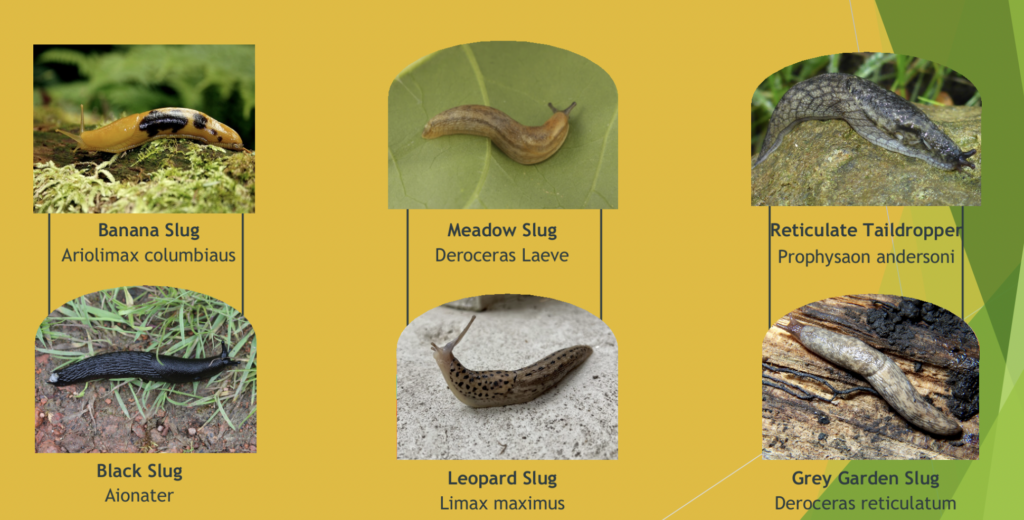
Evidence of a slug problem

  • A dried slime trail left behind
  • Weak or dying plants
  • Irregular shaped holes in leaves, stems, flowers and fruit
  • Seedlings injured or damaged
  • Check any cool, moist areas with shade and you find some

Protecting the garden

First step: Identify the Pest

Slugs are slimy, soft bodied, without legs. Generally muted natural colors, except the banana slug. Has two pairs of feelers, top are the eyes, lowers are used for smelling. Range size from ¼” in to 2” plus. Set a “Refuge trap” to monitor population. Using a flashlight, look for slugs at night.

Use the below strategies or a combination of them to rid your garden of slugs:

  • Manual Control
    Hand removal can be productive if a few slugs exist. Check in the early morning hours on and under leaves, under rocks and debris. Promptly place into a cup of salty or soapy water. Discard dead slugs properly, as the smell is unpleasantly fragrant. Wear gloves during removal, as slugs natural response to predation is to release a large amount of mucus.
  • Natural Predators
    Juvenile slug predators are beetles, frogs and spiders. Mature slug predators are domestic, migratory birds and shrews.
  • Sanitation
    Slugs are attracted to decaying matter, removing dead or half eaten plants helps to maintain proper garden sanitation. Prune lower leaves of plants to increase light exposure; divide or thin plants to improve air circulation to dry out soil; improve drainage of soil.
  • Garden Design
    Plant in rows 12 – 18” apart, applying a barrier in between rows. Stake plants to raise plants off the soil, to reduce access. Create an inhospitable garden by switching wood chips for gravel in garden pathways. Plant perennials that like drier conditions: yarrow, wormwood, milkweed, asters, ornamental grasses, bee balm, sage, tulips or daffodils. Remove materials where slugs hide, such as containers, boards, pavers and flat stones (see the trap technique below). Consider container planting, instead of in-ground.
  • Watering Schedule
    Water in the morning at the base of the plant. Avoid over watering. Water by hand, drip irrigation or use soaker hoses
  • Barriers
    • Copper foil, mesh or bands react with the mucous, giving them an electrical like shock.
    • Electric Slug barrier
    • Raised beds made out of metal or plastic
    • Make a ring of pistachio shells around plants
    • Diatomaceous earth; dries out the mucous layer, but needs multiple application after watering or rain.
  • Baits/Traps
    • Set out beer traps; bury containers level to ground, pour beer or other fermenting liquid that is 6-7’’ deep. As slug tries to take a drink, they fall in and drown.
    • Grapefruit rind, boards or wet newspaper; these will be an attractive place to hide during the day. Check in the morning and discard slugs properly.
    • Sacrificial companion plants
  • Topical Pesticides (store bought and homemade remedies)
    Apply the commercial pesticides in the late afternoon or evening when the slugs become active. Sprinkle product around the plants that are being protected.
    • Iron phosphate is a stomach poison that damages the slug’s digestive system. (Sluggo)
    • Ferric Sodium EDTA is less toxic than iron phosphate, quicker killing time. (Corry’s Slug & Snail Killer)
    • Make your own home made slug spray: Mix 1/3 ammonia to 2/3 water, spray on the slugs that you see on your plants. The Ammonia burns their soft membranes and will kills the slugs.
  • Plants slugs do not like:
    Lavender, rosemary, sage, ferns and nasturtiums, mint and hyssop, garlic and chives.

Hope this helps in the wet and soggy stretches of weather Anchorage can experiences during the growing season.
Categories
Stockpiles

Stockpile Schedule for June 13th (last day!)

This is the LAST DAY of the stockpiles being open for the season.

This has been a great year with stockpiles moving fast! We ask for a donation to help us cover the costs and to continue to make these resources available for free to anyone who needs it. Thank you to everyone for all the donations. Thank you to all the volunteers for doing a great job running the stockpiles! 

Please only access the stockpiles when we are open only. Thank you and Happy Gardening!!

Saturday June 13th 10am-1pm

Resources include TOPSOIL, fresh horse manure, wood chips, free seeds, pots, gardening books, tools and more!!!

Categories
Stockpiles

Stockpile Schedule June 5th-11th

A new schedule will be posted every Friday for the following week.

Anchor Gardens makes these resources available to gardeners every week until Solstice. We ask for a donation to help us cover the costs and to continue to make these resources available for free to anyone who needs it.

We have a great group of volunteers that will help manage the stockpile, answer questions, and help. We got a dumptruck load of topsoil from Green Earth Landworks!

Please only access the stockpiles when we are open only. Thank you and Happy Gardening!!

  • Friday June 5th Closed
  • Saturday June 6th 10am-1pm
  • Sunday June 7th 12-3pm
  • Monday June 8th Closed
  • Tuesday June 9th 5:30pm-7:30pm
  • Wednesday June 10th 4:30pm-6:30pm
  • Thursday June 11th Closed

Resources include TOPSOIL, fresh horse manure, wood chips, free seeds, seedlings, pots, gardening books, tools and more!!!

Categories
Article

Recommended fruit and veggie variety list for Southcentral Alaska

Although our short growing season, colder soils, and unpredictable weather create some interesting challenges, this is a special place to garden. Our longer daylight filled days and low pest levels give us a gardening edge over the Lower 48.

Our fantastic partners at the UAF Cooperative Extension maintain a full list of fruits and vegetables that work for our region!

Two people unveiling the I St. garden beds

Find out what fruits and veggies really work

Although there are many varieties that are not included in the UAF Cooperative Extension listings, the ones that are there have been proven successful in Southcentral Alaska. One of the joys of gardening is discovering new varieties that are successful in your garden. So have fun and try things out in your property’s microclimate. You might just have a spot that grows something extraordinary!

P.S. By extraordinary, we mean something like avocados… We know the science, but we can all still dream right!?

Categories
How to

Composting Corner: Tips for a Thriving Pile!

Composting is a rewarding way to transform kitchen and yard waste into nutrient-rich soil. Here are some answers to common questions we get after holding on of our composting workshops to help you on your composting journey!

Turning Your Compost Pile: When and Why?

Regularly turning your compost pile is crucial for aeration, which helps the decomposition process by providing oxygen to the microbes doing all the hard work.

  • Timing is Key: There’s no strict schedule, but a good rule of thumb is to turn your pile every 3-7 days when it’s actively decomposing and hot. If the pile is new or not heating up, you can turn it less frequently. You’ll notice the temperature drop after turning, but it should quickly rebound if your mix of “greens” (nitrogen-rich) and “browns” (carbon-rich) is balanced and there’s enough moisture.
  • Why Turn? Turning helps distribute moisture and microbes, breaks up clumps, and prevents anaerobic (without oxygen) conditions that can lead to foul odors.

Making a Sifter/Sieve: An Easy Win for Great Soil!

It’s fantastic that you’ve already experienced the benefit of a sifter or sieve for sifting soil! For those looking to make one, it’s a simple DIY project that greatly improves the quality of your finished compost.

  • Why You Need One: A sifter/sieve helps separate finished, fine compost from larger, un-decomposed material, which can then be returned to the compost pile.
  • Simple Construction: You can easily make a sifter/sieve using a sturdy wooden frame and hardware cloth (wire mesh) with 1/2-inch openings. Just staple or screw the hardware cloth to the bottom of the frame. You can even repurpose a wire wastebasket or an old picture frame!

Managing Your Compost Pile: Temperature, Pests, and Winter Woes

  • Temperature Control: A healthy, active compost pile will generate heat (reaching 120-160°F or 49-71°C) as microbes break down organic matter. This heat helps kill weed seeds and pathogens. If your pile isn’t heating up, it likely needs more “greens” (like spent grain, coffee grounds, grass clippings or food scraps) for nitrogen, more moisture (it should feel like a damp sponge), or more turning for aeration.
  • Keeping Pests Away (Mice & Dogs):
    • Mice: To deter mice, ensure your “greens” (especially food scraps) are buried deep within the pile, covered by “browns.” Avoid adding meat, dairy, or oily foods, which are particularly attractive to rodents. A well-constructed, enclosed compost bin can also be very effective.
    • Dogs: The best way to protect your pile from dogs is to enclose it. This could be a sturdy bin with a lid, a fenced-off area, or even a simple wire mesh cage. Dogs are often attracted to food scraps, so burying them deeply also helps.
  • Winter Snow Load: In areas with heavy snow, consider the structural integrity of your compost bin. If it’s an open pile, a heavy snow load can compact it, slowing decomposition. Turning before winter sets in and ensuring your bin is robust enough to handle the weight will help. Decomposition slows significantly in freezing temperatures, but your pile will likely start back up once spring arrives.

Transporting Materials to Your Compost Pile: Making it Easy

  • Strategize Location: If possible, locate your compost pile conveniently close to your kitchen for food scraps and near your garden for yard waste. Except at early phases, it doesn’t need to be observed every day. 
  • Kitchen Caddy: A small, lidded container in your kitchen makes it easy to collect food scraps throughout the day before emptying them into your main compost pile.
    • During the winter, we recommend a container on the kitchen counter that can be emptied into a lidded five-gallon bucket outside your back door. When the bucket fills up, let it thaw inside and then dump it into the compost pile.

Getting Started with Vermicomposting (Worm Composting)

Welcome to the wonderful world of vermicomposting! It’s a fantastic way to compost food scraps indoors.

  • Worms are Your Workers: Red wiggler worms (Eisenia fetida) are the stars of vermicomposting. They eat your food scraps and excrete nutrient-rich “worm castings,” a superfood for plants.
  • Essential Materials:
    • Coco Coir: It’s an excellent bedding material for your worms, providing a moist, airy, and stable environment. Leaf mulch from your yard, shredded newspaper or shredded cardboard also work well. You can purchase a block of coir for about $5 at Alaska Mill and Feed. 
    • Crushed Shells (Grit): Worms don’t have teeth, so they need grit (like crushed eggshells) to help them grind down food in their gizzard. This is an important addition for healthy worms! If you don’t have eggshells to use, oyster shell is available in the poultry sections local feed stores. 

Worm Appetite: How Much Will They Eat?

  • Start Small: When you first get your worms, they’ll be adjusting. Start by feeding them small amounts of food scraps, about 1-2 cups every few days for a pound of worms.
  • Gradual Increase: As they settle in and reproduce, their appetite will increase. A general guideline is that a healthy worm bin can process about half its weight in food scraps per day. So, one pound of worms can eat about half a pound of food scraps daily.
  • Observe and Adjust: The best way to know how much your worms will eat is to observe! If food is disappearing quickly, you can add more. If it’s lingering, reduce the amount. Overfeeding can lead to odors and attract pests.
Categories
Stockpiles

Stockpile schedule June 19-25

(We would love more volunteers to be able to open more often:) 

Stockpiles schedule this week. ( We will continue to update often):

Fri. June 20th 5:30-7:30pm
Sat. June 21st 1-3pm
Sun. June 22nd. 1-3pm

I St Community Garden is our only stockpile location at 14th & I St. Access from alley way next to City Market.

Thank you to all the volunteers stepping up to manage the stockpiles. Folks are really showing up this week so we can open the stockpiles longer and more often! Don’t forget to check out the FREE table. We have LOTS of potted plants, starts, pots and more! This is a great place to bring any extra starts you may have!!

IMPORTANT!! Our stockpiles are managed differently than the Yarducopia Midtown Garden Depot (2930 Cheechako Dr). Yarducopia’s Depot is open 7 days/week from roughly 9-9pm and all resources are free.

Anchor Gardens stockpiles are supported by donations. Help us keep this program going and to support the work of Anchor Gardens. We buy the topsoil from Green Earth Landworks and composted manure from Dave Henke. Our stockpiles are free to those who need it. Please consider donating to https://anchorgardens.org/donate/ to help keep these resources available to Anchorage. 

Stockpiles are only available when there is a volunteer to open them. WHY?? So we can answer questions you may have about Lasagna Gardens, Anchor Gardens, and to help load materials. We need more volunteers to be able to open the stockpiles more often. Contact Theresa at 907-947-8217.

Resources include:

  • topsoil (limit 55 gal or the size of a washing machine)
  • 4 mo. old composted manure (limit 55gal or size of washing machine)
  • wood chips (no limit/ cottonwood)
  • organic garlic starts, organic seed potatoes, strawberries, nettles, onions, comfrey, Angelica potted plants
Categories
Stockpiles

Stockpile schedule June 12-18

(We would love more volunteers to be able to open more often:) 

Stockpiles schedule this week. ( We will continue to update often):

Thurs. June 12th 5-7pm
Sat. June 14th 1-5pm
Sun. June 15th 2-6pm
Mon June 16th 5-7pm

I St Community Garden is our only stockpile location at 14th & I St. Access from alley way next to City Market.

Due to many generous donors we are able to purchase some resources this season and make them available to Anchor Gardens. IMPORTANT!! Our stockpiles are managed differently than the Yarducopia Midtown Garden Depot (2930 Cheechako Dr). Yarducopia’s Depot is open 7 days/week from roughly 9-9pm and all resources are free.

Anchor Gardens stockpiles are supported by donations. Help us keep this program going and to support the work of Anchor Gardens. We buy the topsoil from Green Earth Landworks and composted manure from Dave Henke. Our stockpiles are free to those who need it. Please consider donating to https://anchorgardens.org/donate/ to help keep these resources available to Anchorage. 

Stockpiles are only available when there is a volunteer to open them. WHY?? So we can answer questions you may have about Lasagna Gardens, Anchor Gardens, and to help load materials. We need more volunteers to be able to open the stockpiles more often. Contact Theresa at 907-947-8217.

Resources include: 

  • topsoil (limit 55 gal or the size of a washing machine)
  • 4 mo. old composted manure (limit 55gal or size of washing machine)
  • mushroom substrate (limit 4 bags /car load)
  • woodchips (no limit/ cottonwood)
  • strawberries, nettles, onions, comfrey, Angelica potted plants

Categories
Stockpiles Uncategorized

Stockpile Schedule June 6-11

(We would love more volunteers to be able to open more often:) 

Stockpiles schedule this week. ( We will continue to update often):

Fri June 6th. 5:00-7:00pm
Sat June 7th 1:00-3:00pm 
Mon June 9th 4:00-6:00pm

I St Community Garden is our only stockpile location at 14th & I St. Access from alley way next to City Market.

Due to many generous donors we are able to purchase some resources this season and make them available to Anchor Gardens. IMPORTANT!! Our stockpiles are managed differently than the Yarducopia Midtown Garden Depot (2930 Cheechako Dr). Yarducopia’s Depot is open 7 days/week from roughly 9-9pm and all resources are free.

Anchor Gardens stockpiles are supported by donations. Help us keep this program going and to support the work of Anchor Gardens. We buy the topsoil from Green Earth Landworks and composted manure from Dave Henke. Our stockpiles are free to those who need it. Please consider donating to https://anchorgardens.org/donate/ to help keep these resources available to Anchorage. 

Stockpiles are only available when there is a volunteer to open them. WHY?? So we can answer questions you may have about Lasagna Gardens, Anchor Gardens, and to help load materials. We need more volunteers to be able to open the stockpiles more often. Contact Theresa at 907-947-8217.

Resources include: 

  • topsoil (limit 55 gal or the size of a washing machine)
  • composted manure (almost gone)
  • mushroom substrate (limit 4 bags /car load)
  • woodchips (no limit)
Categories
Stockpiles

Stockpiles Schedule May 28-June 1, 2025

(We would love more volunteers to be able to open more often 🙂 

The I St Community Garden is our only stockpile location so far, located at 14th & I St. Access from alley way next to City Market.

Stockpiles schedule this week (we will continue to update often):

Thurs May 29th 4-6pm
Fri May 30th. 4:30-7:30pm
Sat May 31st. 12:30-2:30pm
Sun June 1st 12-2pm an 6-8pm

Resources include: 

  • topsoil (limit 55 gal or the size of a washing machine)
  • composted manure (almost gone)
  • mushroom substrate (limit 4 bags /car load)
  • free tomatoes!!! Take as many as you want 🙂
  • a few pots of different sizes

Due to many generous donors we are able to purchase some resources and make them available to Anchor Gardens. IMPORTANT!! Our stockpiles are managed differently than the Yarducopia Midtown Garden Depot (2930 Cheechako Dr). Yarducopia’s Depot is open 7 days/week from roughly 9-9pm and all resources are free.

Anchor Gardens stockpiles are supported by donation to help us keep this program going and to support the work of Anchor Gardens. We buy the topsoil from Green Earth Landworks and composted manure from Dave Henke. Our stockpiles are free to those who need it. Please consider donating to https://anchorgardens.org/donate/ to help keep these resources available to Anchorage. 

Stockpiles are only available when there is a volunteer to open them. WHY?? So we can answer questions you may have about Lasagna Gardens, Anchor Gardens, and to help load materials. We need more volunteers to be able to open the stockpiles more often. Contact Theresa at 907-947-8217.

Categories
Stockpiles

Stockpile is open May 24, 25, 26 2025

Stockpile schedule this week ( Theresa will continue to update often as she gets more volunteers, so check back often!):

Sat May 24th from 12-2pm
Sun May 25th from 1-3pm

Mon May 26th from 10am-12pm

At I St Community Garden located at 14th & I St. Access from alley way next to City Market. It is our only stockpile location so far for this season.

Resources include:

  • Topsoil (limit 55 gal or the size of a washing machine)
  • composted manure (limit 55gal or the size of a washing
  • machine)
  • mushroom substrate (limit 4 bags /car load
  • free tomatoes & peppers
  • a few pots of different sizes